
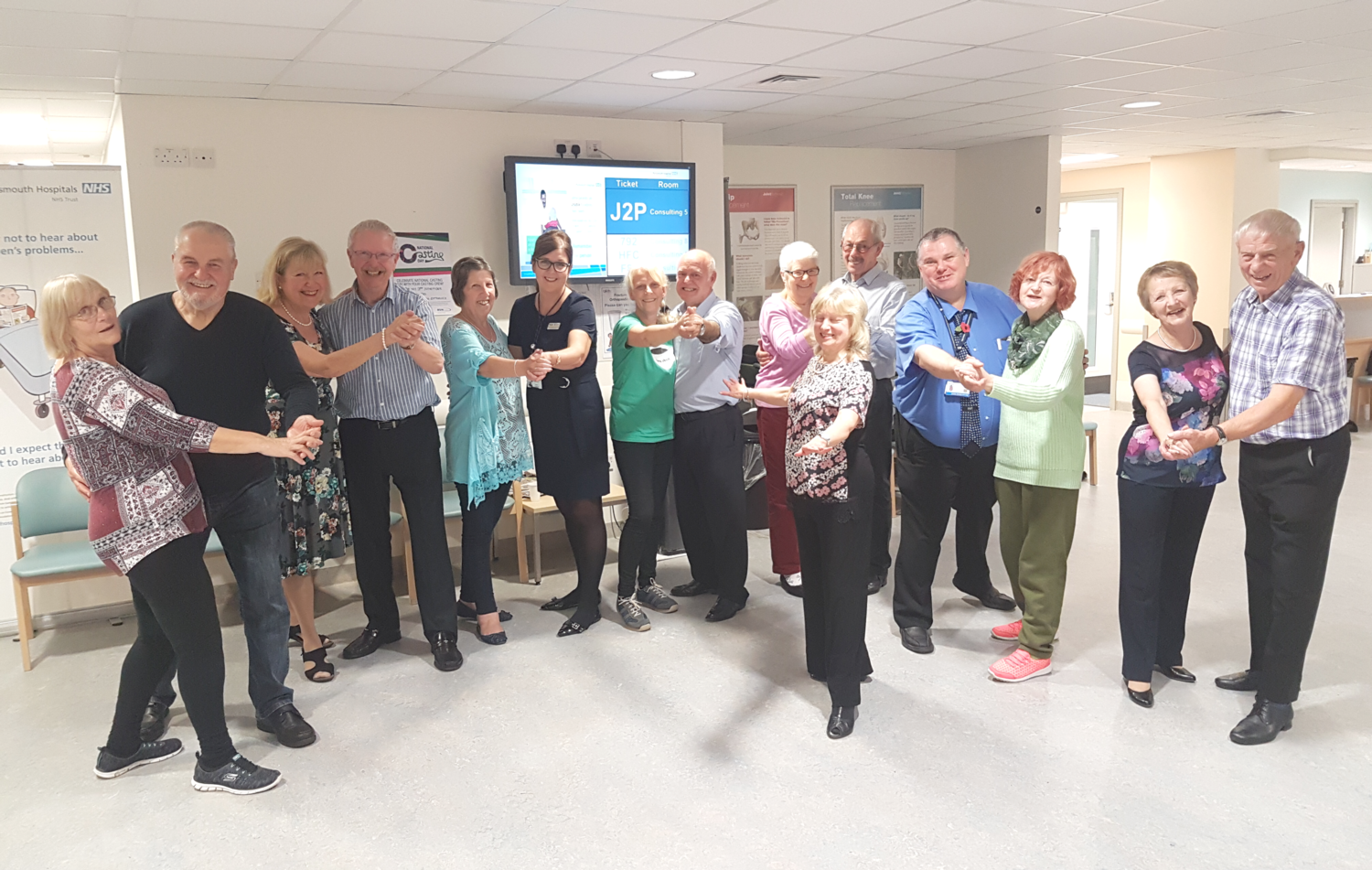
 Fourteen patients and their partners and staff from the Department of Rheumatology are about to complete their 6-week ballroom class. Over the weeks they will have taken an additional 12,000 steps and exercised for around extra 5.5 hours.
Claire Jeffries, Rheumatology Specialist, Physiotherapist and Hydrotherapy Manager, points out that there are many health benefits of dancing: “it’s great for people of all ages, shapes and sizes”.
Dancing offers a wide range of physical and mental benefits:
- improved condition of your heart and lungs
- increased muscular tone, strength, endurance and motor fitness
- increased aerobic fitness
- weight management
- stronger bones and reduced risk of osteoporosis
- better coordination, balance, agility and flexibility
- increased physical confidence
- improved mental functioning and psychological wellbeing
- greater self-confidence and self-esteem
The Department of Rheumatology would encourage people living with Arthritis and connective tissue diseases to consider dance as a form of activity.…
Read more of this article

 This exciting initiative aims to support the development of assistive products that help people living with arthritis and musculoskeletal conditions to live well, to help people be independent and to be in control of their lives as much as possible.…

 The British Orthopaedic Association (BOA) is pleased to announce the recent publication of four revised commissioning guides with the Royal College of Surgeons of England. These NICE-accredited guides set out best practice care pathways to assist CCGs in designing optimal care for their populations. We are extremely grateful to all those involved in the rigorous development and accreditation processes. The guides, which can be found here, are:


 In July LUPUS UK released the newest edition in their range of publications, ‘LUPUS: Bone Health & Osteoporosis’.
 The current delay to diagnosis of ankylosing spondylitis (AS) stands at 8.5 years. NASS are committed to reducing this delay to diagnose. There are many factors impacting on this delay but an important issue is the recognition of AS in primary care and prompt referral on to rheumatology.
 On 10th July 2017, NICE issued a new Technology Appraisal (TA) for bisphosphonates which links the recommendations for drug treatments to advice on fracture risk assessment outlined in their earlier guidance. The TA is not intended to provide treatment thresholds but offers recommendations on cost-effective use of bisphosphonates when using fracture risk assessment as described in their guideline
 On Monday 8th May 2017 the Scottish Medicines Consortium (SMC) published new advice accepting the restricted use of belimumab (Benlysta) by NHS Scotland for lupus patients. This advice was published following a re-submission with evidence supplied by GlaxoSmithKline (the producers of Benlysta) and LUPUS UK on behalf of patients.