
 Guest Blog by Deborah Alsina MBE, Chief Executive of Arthritis UK
Across England, people with arthritis are being left to wait in pain for joint replacement surgery that could transform their lives. Almost a fifth of ICBs are ignoring NICE guidelines and rationing surgeries based on a single arbitrary threshold, a patient’s BMI. Moreover, a further 54.7% have policies that restrict or alter access to surgery in some other way for those who are overweight or have obesity. Joint replacement surgery is not a lifestyle choice; it’s the bridge from living in constant pain to regaining independence.
Our newly published briefing builds on ARMA’s 2017 position paper, which raised concerns about restrictions on access to joint replacement surgery and found that 47% of clinical commissioning groups restricted access to joint replacement surgery based on being overweight or obesity. Nearly a decade on, the same concerns remain. Decisions about surgery should be based on individual clinical need, in line with NICE guidelines, not BMI thresholds.
The unjust impacts
BMI threshold policies uphold a postcode lottery system as a patient’s access to surgery can depend entirely on where they live. For example, a patient with a BMI above 35 will be denied surgery with Lincolnshire ICB but may qualify for surgery at Leicester, Leicestershire and Rutland ICB, where their cut-off point is a BMI above 45. In practical terms a difference of about 13kg can determine whether someone receives life-changing treatment or is left in pain.
The policies also disproportionately affect people in deprived areas where osteoarthritis is more prevalent. Higher rates of obesity in these areas also accounts for around a 50% extra risk of knee osteoarthritis. Although these communities have the greatest need, they tend to have limited access to the required support leaving these patients at a greater disadvantage when it comes to accessing treatment.
Health inequalities are compounded further when weight loss injections are accessible through private providers and joint replacement surgery can still be accessed privately, but these options are only available to those who have the means to afford them. This creates a two-tiered healthcare system. Such policies do not just delay treatment, but they deepen inequalities.
Time spent waiting is time spent in pain
 For people with arthritis, delays to life-changing surgery can result in prolonged pain and further deterioration of their joints. Waiting in pain can restrict people’s ability to take part in activities that give life meaning. For example, Arthritis UK’s Left Waiting, Left Behind survey found 68% of respondents stated that waiting for treatment had impacted their ability to work and 73% said that it impacted their social activities. People with arthritis should not have to put their lives on hold because of an arbitrary threshold, instead decisions about surgery should be made through shared decision making.
What do we want to see?
The publication of the report comes at a pivotal moment in the restructuring of ICBs, which presents an important opportunity to review local policies and ensure that access to surgery is based on clinical need rather than arbitrary thresholds. As local systems are reshaped, ICBs should end the rationing of joint replacement surgery and align their policies with NICE guidelines.
For more information, please read the report:
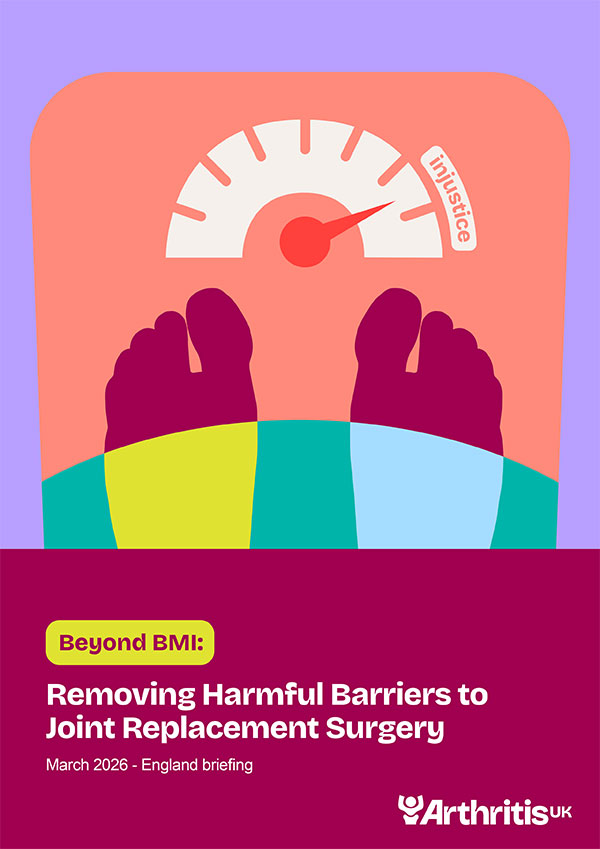
Beyond BMI: Removing Harmful Barriers to Joint Replacement Surgery | Arthritis UK